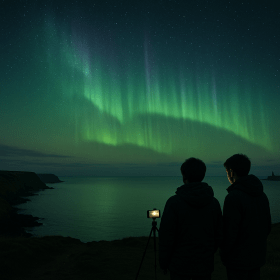
On some recent nights, your feed filled with glowing skies and excited posts from friends who’ve never seen an aurora before. The Northern Lights didn’t stay locked to the Arctic—they reached the UK, lighting up skies from Scotland and, during the strongest storms, even much farther south. So what’s going on up there? Here’s the quick science, how to spot them next time, and a few myths we can finally bin.
What are the Northern Lights, really?
The Sun constantly sends out a stream of charged particles called the solar wind. Earth’s magnetic field guides some of those particles towards the polar regions. When they hit gases high in our atmosphere, they pass on energy. The gases then release that energy as light—an aurora.
- Colours: Oxygen glows green at mid-heights and deep red higher up. Nitrogen can glow pink, purple or blue.
- Shape: Curtains, arcs and rays form along invisible magnetic field lines.
- Speed: The patterns can drift slowly or ripple quickly as the solar wind changes.
Why did they reach the UK? (Hello, solar maximum)
The Sun runs on an ~11-year cycle. Near solar maximum, it grows spotty and stormy, firing off bursts of magnetised plasma called coronal mass ejections (CMEs). When a strong CME arrives at Earth, it triggers a geomagnetic storm. The auroral “oval” around each pole swells and slides south, which is why the Northern Lights can suddenly show over the UK—sometimes even beyond.
Key idea: it’s space weather, not cold weather. Clear, dark skies help you see them, but the real driver is what the Sun is doing.
How to spot them in Britain (your quick checklist)
Want a real chance next time? Use this plan:
- Watch the alerts. Follow reliable space-weather updates (e.g., UK aurora alert services or national forecasters). If you see talk of Kp 6–7, that’s promising for much of the UK; Kp 8–9 can push the lights far south.
- Pick your place. Go for dark, open horizons with a clear view north. Beaches, moorland car parks and hilltops beat bright town centres every time.
- Time it right. Aim for 9pm–2am. Peak bursts can come in waves, so give it more than a quick look.
- Let your eyes adapt. Avoid bright screens for 20 minutes so your night vision wakes up.
- Use your phone camera. Switch to night/long-exposure mode. Your camera can catch colours your eyes miss, especially under light pollution.
- Dress and prep. It gets chilly standing still. Bring layers, a torch with red mode, and a flask. Safety first—tell someone where you’re going.
Myth-busting: facts that help you actually see them
- “You can only see them in Scotland.” False. Scotland has the best odds, but strong storms can push the lights across England, Wales and Northern Ireland.
- “It needs to be freezing.” Nope. Temperature doesn’t cause auroras—solar activity does. You only need dark, clear skies.
- “If I don’t see bright green, there’s nothing.” Not true. To your eyes, faint auroras can look silver or grey. Your camera often shows the greens and purples.
- “Full Moon = no chance.” A bright Moon makes faint auroras harder, but strong displays can still shine through.
- “Auroras damage your eyes.” Watching them is safe. The risk is to satellites and power systems, not your eyesight.
- “Solar flares and CMEs are the same.” They’re related but different. Flares are flashes of light and energy. CMEs are big clouds of magnetic plasma that can supercharge auroras.
Quick science: what’s the Kp index?
Kp runs from 0 (quiet) to 9 (extreme) and describes how disturbed Earth’s magnetic field is. Bigger Kp = auroras visible farther from the poles. For most of the UK, Kp 6–7 is worth staying up; Kp 8–9 can create sky-wide shows.
So, next time your phone pings with “storm incoming,” ask yourself: Where’s my nearest dark north-facing view, and who am I taking with me to chase the glow?