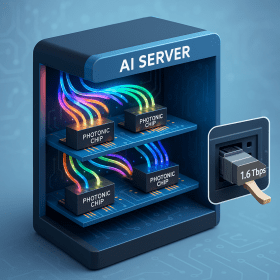
What if computers sent information with beams of light instead of tiny bursts of electricity? That’s the promise of photonic chips—a new kind of hardware that could make AI faster, cooler, and far more energy-efficient. Right now, big tech and chip makers are racing to plug light into the heart of data centres and devices. In 2025, companies like AWS with STMicroelectronics and TDK announced breakthroughs that push this future much closer.
What are photonic chips?
Photonic chips use photons (light particles) to move information instead of electrons (electric charge). Light travels incredibly fast and can carry multiple “colours” (wavelengths) at once through the same thin fibre. That means more data can move with less heat and less energy compared to copper wires. Think of it like upgrading from a single-lane road to a rainbow-coloured motorway where every colour is a separate lane.
Why light beats wires (most of the time)
- Speed & bandwidth: Light can carry many channels together using a trick called wavelength-division multiplexing (WDM).
- Energy: Pushing electrons through long copper links wastes power as heat. Photonics can cut that waste, which matters when AI servers run 24/7.
- Distance: Electrical signals fade over metres at very high speeds. Optical links can keep signals clean over much longer runs.
Together, these wins can shrink electricity bills for huge AI clusters—good news for the planet and your phone battery in the long run.
Where you’ll see it first: AI data centres
Before photonic chips end up in your laptop, they’re transforming the connections inside AI data centres—the digital factories that train chatbots and image generators. In February 2025, STMicroelectronics and AWS revealed a silicon-photonics platform (PIC100) for super-fast optical modules—designed to move data at speeds up to 1.6 terabits per second for next-gen AI networks. Mass production is planned at ST’s Crolles, France fab.
Another big push comes from startups building “optical highways” between chips. Lightmatter announced its Passagephotonic interconnect—aimed at linking mountains of AI chips with light instead of copper. The company is rolling out hardware through 2025, working with major manufacturers to bring it to market.
How this could change everyday tech
- Smarter phones & laptops: Moving data with light could shave off power use, meaning cooler devices and longer battery life when running AI tools.
- Faster cloud apps: Lower-energy data centres can serve more AI to more people, quicker and cheaper.
- AR/VR and robotics: Ultra-fast sensors and cameras need rapid, low-latency links—perfect for photonic tech.
In April 2025, TDK showed a new “spin photo detector”—a light sensor technology with 20-picosecondresponse times (that’s 20 trillionths of a second). It’s early days, but it hints at faster, more efficient optical parts for future AI systems.
But it’s not magic: the hard problems
If photonics is so great, why aren’t all computers using it already?
- Getting light on and off chips: You need tiny lasers, modulators, and detectors precisely built into or near the chip. Packaging all that is tricky.
- Cost & complexity: Optical parts have to be made at scale and survive hot, busy server racks.
- What to integrate where: Do we keep optics as pluggable modules or co-package them right next to the switch or GPU? Even giants like NVIDIA say full integration is coming, but the industry is still testing what works best at massive scale.
What’s new in 2025—and what to watch next
- AWS + STMicro (SiPho PIC100): A platform for ultra-fast optical links aimed at AI clusters; pluggable optics targeting 1.6 Tbps lanes and volume production beginning in 2025.
- Lightmatter Passage: Photonic interconnect “superchips” to speed up chip-to-chip communications in 2025 pilot deployments.
- TDK spin photo detector: Prototype tech with 10× faster response than common semiconductor photodetectors; samples planned for 2026 if development stays on track.
- The bigger picture: Expect trials of co-packaged optics and wider 1.6T optical modules through 2025–2026 as data centres chase higher bandwidth with lower power.
So, where does this leave you?
Right now, photonic chips won’t replace every transistor inside your CPU. Instead, they’ll handle the data highwayswhile silicon keeps doing the logic. But as AI models grow and power limits bite, light is stepping in to carry the load.
Quick reflection:
The next time an AI tool answers you in a blink, ask yourself: Was that speed thanks to a smarter algorithm—or because your data took a shortcut on a beam of light?