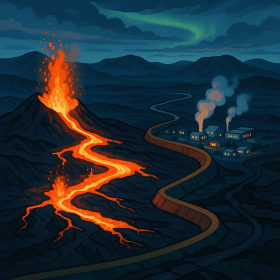
Imagine waking up to the rumble of earthquakes, seeing glowing lava on the horizon, and checking whether school, work, or the Blue Lagoon is open today. That’s life near Grindavík on Iceland’s Reykjanes Peninsula. Since 2021, a chain of fissure eruptions—sometimes called an “eruption row”—has kept bursting to the surface. This teen-friendly guide explains the science behind it: dykes (the underground cracks that feed eruptions), lava walls, and why the activity could continue for decades. If you’ve heard the phrase “Reykjanes eruption row,” here’s what it actually means.
Where on Earth is the Trouble?
Reykjanes sits where two giant tectonic plates—the North American and Eurasian plates—pull apart. Iceland is one of the few places on Earth where the mid-ocean ridge pops out of the sea and onto land. As the plates drift, the crust stretches and tears. Magma rises to fill the gaps, sometimes gently as hot fluids, sometimes dramatically as lava.
Since 2021, several eruptions have happened on short fissures rather than from a classic cone-shaped volcano. These long cracks split open the ground, letting lava fountain out in lines. They’ve mostly been small to moderate events by global standards, but they’re close to people, roads, and power lines. That’s why they grab headlines.
What Is a Dyke, and Why Do Fissures Open?
A dyke (geology spelling often seen as “dyke” in the UK, “dike” in the US) is a vertical sheet of magma that forces its way through rock. Picture pushing jam between two layers of a cake. The jam finds weak points and spreads in a thin blade. Underground, magma does the same. It moves sideways, often for kilometres, cracking the rock as it goes.
When a dyke gets close enough to the surface, pressure and heat can split the ground open. This makes a fissure eruption—a line of vents rather than one central crater. Because the lava is usually runny basalt, it flows easily, building wide lava fields rather than tall mountains. That’s why these Reykjanes eruptions can look like glowing orange curtains along a crack.
Eruption Row: A Stop–Start Pattern
Reykjanes tends to erupt in episodes. History shows long quiet times (hundreds of years), then clusters of activity where several eruptions happen over a few years or decades. Since 2021, magma has repeatedly pushed up along a few preferred lines, including the area north of Grindavík. Each time the underground reservoir refills, pressure builds. When the rock can’t take it anymore, a new dyke intrudes and a fissure may open.
The pattern can be frustrating: a burst of activity, a pause, then another burst. People sometimes ask, “Isn’t it over now?” But the system doesn’t run on a school timetable. If the deep supply keeps feeding the shallow pipes, stop–start eruptions can continue on and off for a long time. That’s the “row” bit—multiple fissures popping along the same general line, months apart.
Lava Walls and Life in Grindavík
When lava threatens towns or power stations, you can’t move a volcano—but you can try to steer the lava. Iceland has built substantial lava walls (earth embankments) to divert flows from critical sites like the Svartsengi geothermal power plant and parts of Grindavík. These walls don’t stop lava completely; they nudge it, like a curb nudges rainwater down a different gutter.
In some eruptions, the barriers have held long enough to save buildings and buy time for evacuations. In others, new fissures opened outside the defences, reminding everyone that nature doesn’t always play by our rules. Roads have been cut and rebuilt, the Blue Lagoon has closed and reopened more than once, and people have adapted: remote operations for power plants, rapid-response evacuations, and constant monitoring of gas and ground cracks.
A surprising fact: some of these protective walls reach towering heights—think of a five-storey building made of compacted rock and soil. That scale shows just how serious Iceland takes this challenge.
Will This Go On for Decades?
It might. Geological records from Reykjanes suggest eruptive cycles—busy stretches separated by long breaks. We appear to be in a busy stretch again. That doesn’t mean constant disaster. Instead, expect a series of short eruptions, pauses, rebuilding, and more eruptions. Flights have mostly carried on as normal because these events produce little ash, but gas can be a problem locally. For residents, the biggest impacts are ground cracking, lava on roads, and the stress of not knowing exactly when the next fissure will open.
So, as you scroll the next headline, ask yourself: “Is this one a repeat of the pattern—short, local, and mostly effusive—or something bigger?” Learning to read the signs—earthquakes, land uplift, magma movement—helps people plan. It’s science directly improving safety.
What This Teaches Us About Earth
Reykjanes is a living laboratory. It shows how plate tectonics, magma plumbing, and human engineering play out in real time. We learn how fast dykes move, how fissures choose their paths, and which kinds of defences work best. Engineers test barrier shapes and heights. Geologists map lava thickness and gas. Emergency teams refine evacuation routes.
Next time you see a clip of glowing lava, what do you think you would do if you lived there? Would you pack a go-bag? Would you check the latest hazard map? Real people answer those questions every week, and science helps them make the safest choices possible.
In the end, the “Reykjanes eruption row” isn’t a mystery monster. It’s the natural result of plates pulling apart and magma finding the easiest route up. The story may run for years. But with good monitoring, smart barriers, and quick decision-making, communities can live with a restless Earth—and keep the lights on while they do it.