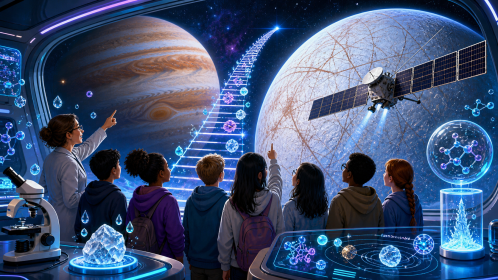
For centuries, people have stared up at the stars and wondered: Are we alone in the universe? Now, thanks to powerful space telescopes, robot missions to Mars, and new research, scientists are closer than ever to finding out.
But the truth is both exciting and a little complicated.
🛸 What do we mean by “life”?
Before we imagine aliens in spaceships, we need to understand what scientists are actually looking for. When they talk about “life,” they usually mean simple life forms — like bacteria or tiny microbes. These would be the space version of the first life on Earth. They might live under ice, deep underground, or in oceans beneath frozen moons.
Finding even the tiniest life would be a huge deal. It would prove that Earth isn’t the only place where life can grow.
🔭 So, have we found anything yet?
Not quite — but we’ve found strong clues. Some of the most promising places include:
- Mars – Dry and dusty now, but once had rivers and lakes. Scientists think there could still be life hiding underground.
- Europa – One of Jupiter’s moons. It has a salty ocean beneath its icy shell — and where there’s water, there could be life.
- Enceladus – A tiny moon of Saturn that sprays watery plumes into space. Scientists are eager to test those plumes for signs of life.
- Exoplanets – These are planets orbiting other stars. Some are the right temperature for liquid water, which is a big deal.
NASA’s James Webb Space Telescope and other powerful instruments are scanning these distant worlds for signs of gases like oxygen and methane, which could hint at living organisms.
👽 What would it mean if we did find life?
Even if we only find alien microbes, it would completely change how we see ourselves.
Think about it: for all of history, humans believed Earth was special. If life exists elsewhere, then life might be commonin the universe. That makes our galaxy feel a lot more crowded — and a lot more mysterious.
It could also push science forward. Learning how alien life survives might help us fight disease, understand evolution, or even find new ways to protect our own planet.
But it raises big questions too. Should we try to contact other lifeforms? What if they’re more advanced than us? Would finding alien life make some people rethink what it means to be human?
🌠 Reflection Question:
If we discovered life on another planet tomorrow, would it make you feel smaller in the universe — or more connected to it?