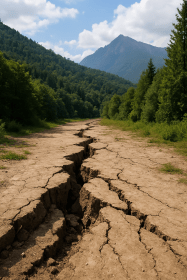
Have you ever felt the ground shake beneath your feet? It can be a scary experience — and it’s caused by something powerful happening deep underground. These events are called earthquakes.
But what causes them? Where do they happen most? And how do scientists measure them?
Let’s find out.
What Is an Earthquake?
An earthquake is when the ground shakes or moves suddenly. It happens when huge slabs of rock under the Earth’s surface — called tectonic plates — grind against each other, slide, or get stuck and then suddenly slip.
That sudden movement sends energy through the ground. This energy travels as waves, and when it reaches the surface, we feel it as shaking.
What Causes Earthquakes?
Most earthquakes happen at the edges of tectonic plates. These plates are always moving — but very slowly. Sometimes they get stuck. Pressure builds up over time, and eventually something has to give. When the pressure is too much, the rocks break or slip suddenly, causing an earthquake.
The point underground where this happens is called the focus, and the spot on the surface above it is called the epicentre.
How Do We Measure Earthquakes?
Scientists use a tool called a seismograph to detect and measure earthquakes. They record how strong the shaking is and how long it lasts.
Earthquake strength is measured on the Richter scale or the moment magnitude scale. Here’s a quick guide:
- 2.0 or less – usually not felt
- 3.0 to 4.9 – small but may be noticed
- 5.0 to 6.9 – moderate to strong, can damage buildings
- 7.0 and above – very strong, often causes major destruction
Where Do Earthquakes Happen?
Some parts of the world have earthquakes more often. These are usually places near tectonic plate boundaries. For example:
- Japan
- California (USA)
- Chile
- Indonesia
- Turkey
In the UK, earthquakes are rare and usually quite small — but they do happen!
Can We Predict Them?
Right now, scientists can’t predict the exact time or place of an earthquake. But they can monitor risk zones, study past patterns, and improve building safety to reduce damage when one happens.
In earthquake-prone countries, buildings, bridges, and roads are often designed to withstand shaking and protect people.
What Should You Do During an Earthquake?
If you ever experience an earthquake, remember:
- 🔽 Drop to the ground
- 🛡️ Cover your head and neck
- 🧍♂️ Hold on to something sturdy
- 🏃 Don’t run outside until it’s safe
These simple steps can help keep you safe.