
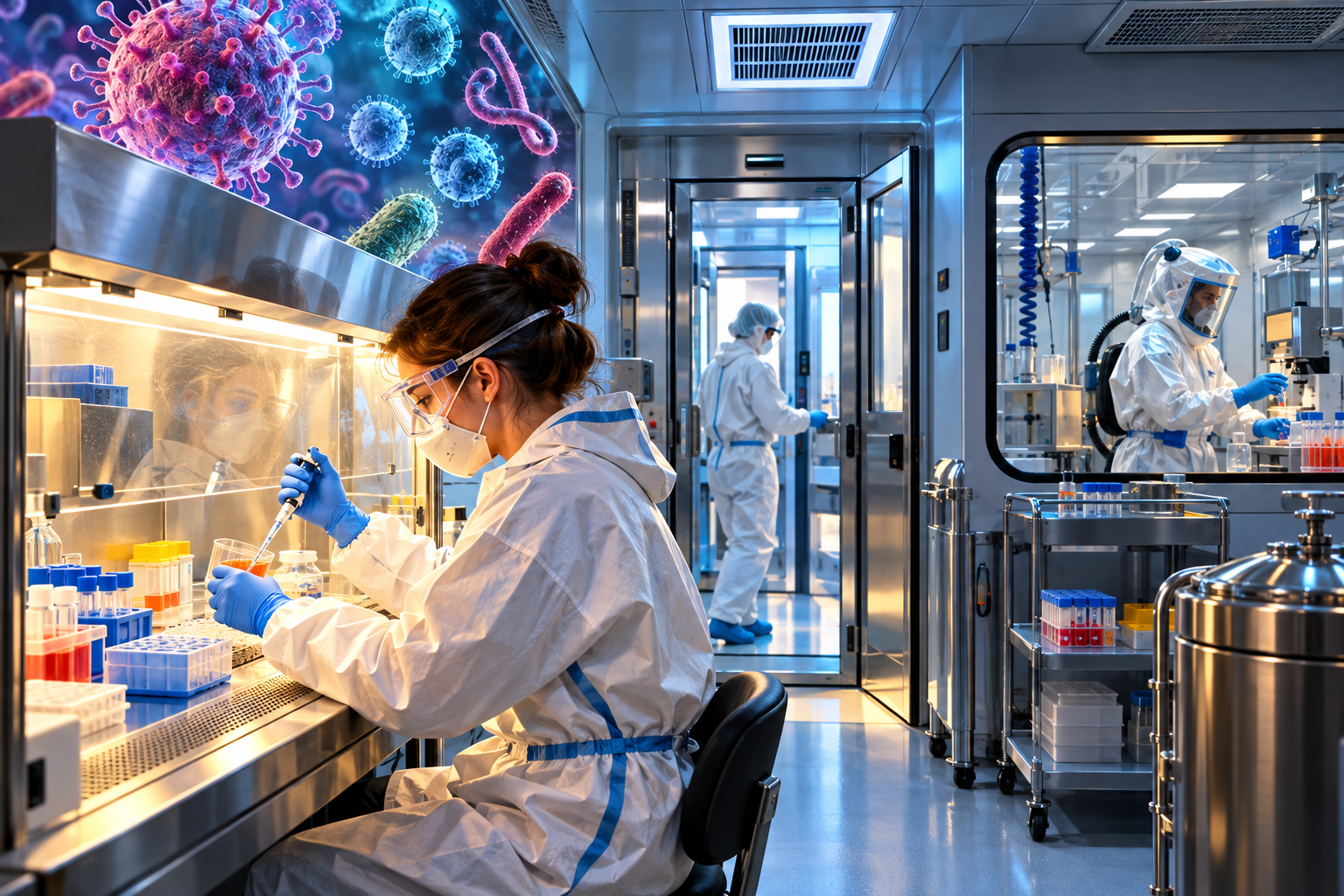
Imagine working in a laboratory where the microbes being studied could cause some of the most dangerous diseases on Earth. Scientists sometimes need to investigate deadly diseases so that we can diagnose infections, develop treatments, create vaccines and prepare for future outbreaks. However, this research cannot happen like an ordinary school science practical.
Instead, researchers use layers of disease laboratory safety. Special buildings, equipment, training and strict rules work together to protect scientists, the public and the environment.
Why Study Dangerous Diseases at All?
It might seem safer simply to leave dangerous microorganisms alone. Unfortunately, the diseases they cause would not disappear just because scientists stopped studying them.
Researchers investigate dangerous pathogens for several important reasons. They may need to understand how a virus enters human cells, why one bacterium causes severe disease while another does not, or how the immune system responds during infection.
Scientists can then use this knowledge to develop vaccines, medicines and diagnostic tests.
Research also helps scientists monitor diseases already circulating in nature. For example, viruses can sometimes move from animals into humans. This is called zoonotic transmission. Understanding these infections can help health organisations recognise outbreaks before they become much larger.
However, the more dangerous the organism, the greater the precautions researchers must take.
Biosafety Levels: Matching Protection to the Risk
Laboratories use different levels of containment depending on the organisms being studied. These are commonly described as biosafety levels, ranging from BSL-1 to BSL-4.
BSL-1 laboratories handle microorganisms that pose little risk to healthy people. Many teaching laboratories operate around this level.
BSL-2 laboratories work with organisms capable of causing human disease but which can usually be controlled using established precautions and treatments.
BSL-3 laboratories deal with microorganisms that may cause serious disease, particularly when infection could occur through the air. Access becomes much more restricted and specialised containment systems become important.
BSL-4 represents the highest level of biological containment. These facilities can study extremely dangerous pathogens that may cause severe or fatal diseases and for which effective treatments may be limited.
Interestingly, a BSL-4 laboratory is not simply a normal laboratory with stronger protective clothing. The entire building may form part of the safety system.
How High-Containment Laboratories Protect People
Safety depends on using several barriers rather than trusting one piece of equipment.
Researchers receive extensive specialist training before working with dangerous organisms. Access to laboratory areas is tightly controlled, and scientists follow carefully designed procedures.
Work involving hazardous biological material can take place inside biosafety cabinets. These enclosed workspaces control airflow and help prevent microorganisms escaping into the laboratory.
High-containment laboratories may also control the direction in which air moves. Air is designed to move towards higher-risk areas rather than away from them. This helps reduce the chance of contaminated air spreading into other parts of a building.
Air leaving some containment facilities passes through specialised filtration systems such as HEPA filters, which can trap extremely small particles.
Surfaces, equipment and waste also need careful decontamination. One important tool is an autoclave, which uses high-pressure steam to destroy microorganisms.
Researchers may wear protective clothing ranging from laboratory coats, gloves and eye protection to highly specialised protective suits depending on the laboratory and the pathogen.
Each system adds another layer of defence.
What Happens if Something Goes Wrong?
Scientists assume that humans and equipment can sometimes fail. Therefore, laboratories try to build safety systems around this possibility.
Researchers report spills, damaged equipment and possible exposure incidents immediately. Laboratories can then isolate affected areas, assess what happened and begin appropriate medical monitoring if necessary.
Facilities also use emergency plans.
For example, backup power may help maintain important containment systems if electricity fails. Laboratories regularly inspect safety equipment and test procedures rather than waiting for an emergency to discover whether something works.
This idea is known as redundancy.
It means that if one protection fails, another protection can still reduce the risk.
A secure laboratory might therefore combine restricted access, protective clothing, controlled airflow, specialised equipment, waste treatment, staff training and emergency procedures.
No single system carries all the responsibility.
Safety Goes Beyond the Laboratory
Scientists also have to think about biosecurity.
Biosafety mainly focuses on preventing accidental exposure or release. Biosecurity focuses on preventing dangerous biological materials, equipment or information from being deliberately misused.
This creates an important scientific challenge.
Research that helps scientists understand disease can be extremely valuable. However, some knowledge could potentially be misused. Scientists sometimes describe this as dual-use research because the same discovery could have both beneficial and harmful applications.
As a result, research involving particularly dangerous pathogens may require additional reviews, licences, inspections and ethical oversight.
Scientists must ask not only, “Can we do this research?” but also, “Should we do it, and how can we reduce the risks?”
That balance matters.
We need scientists capable of studying dangerous diseases because future outbreaks are inevitable. Yet society also expects that research to take place responsibly.
Next time you hear about researchers investigating a deadly virus or bacterium, ask yourself: would stopping the research make us safer, or could carefully controlled research actually help protect us?
The answer is rarely as simple as choosing between research and safety. Modern disease science tries to achieve both.



Leave a Reply