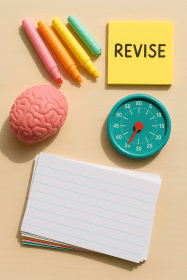
Revising for tests and exams can feel overwhelming. But don’t worry—there are smart ways to study that can help you remember more in less time. The trick? It’s all about using the right techniques.
Let’s explore some top revision methods backed by science.
🔁 1. Spaced Practice: Spread it out!
Cramming the night before a test might feel productive, but your brain forgets most of it quickly. Instead, try spaced practice—studying the same topic several times over a few days or weeks.
Example:
- Day 1: Learn it
- Day 3: Review it
- Day 6: Quiz yourself
- Day 10: Go over tricky parts again
Spaced practice helps move knowledge into your long-term memory.
💬 2. Retrieval Practice: Quiz yourself
Retrieval practice means trying to remember something without looking at your notes. This could be:
- Doing a past paper
- Writing down everything you know about a topic
- Using flashcards
It’s one of the best ways to test what you know—and spot gaps in your learning.
📄 3. Dual Coding: Use words + pictures
Dual coding means combining images and text. This helps your brain build stronger memory links.
Try creating:
- Mind maps
- Diagrams with labels
- Comic-style notes
Seeing information in different ways makes it easier to understand and remember.
📝 4. Chunking: Break it down
Your brain finds it easier to remember small chunks of information. Instead of learning a whole topic in one go, break it down into smaller parts.
Example:
Instead of “The Water Cycle,” study:
- Evaporation
- Condensation
- Precipitation
- Collection
Once you understand each chunk, put them together again.
📚 5. Interleaving: Mix it up
Instead of revising one subject for hours, try switching between different topics or subjects during your study session.
For example:
- 20 mins on Biology
- 20 mins on English
- 20 mins on Maths
This helps your brain stay focused and makes it easier to link ideas across subjects.
🧘♀️ 6. Sleep, Exercise, and Breaks Matter
Don’t forget—your brain needs rest to remember things properly.
- Sleep helps your brain lock in new information.
- Exercise boosts blood flow to the brain.
- Breaks stop your brain from getting tired.
Use the Pomodoro technique:
🕒 25 minutes study
🔔 5-minute break
Repeat 4 times, then take a longer break.
✨ Final Tips
- Make your own notes—don’t just copy.
- Turn your notes into questions and test yourself.
- Study with a friend and teach each other.
- Start early. Little and often beats one long session.
Reflection question:
What’s one revision technique you haven’t tried yet—but could test out this week?