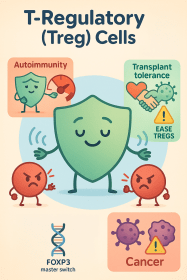
Have you ever had a cold and wondered how your body knows when to fight—and when to stop? If your immune system never hits the brakes, it could start attacking you. That’s where T-regulatory cells (Tregs) come in. They’re like the referees of immunity, keeping the game fair and calm. And this year’s Nobel Prize in Physiology or Medicine (2025) celebrated exactly that discovery—how the body prevents its own defence force from going too far.
What are T-regulatory cells?
T-regulatory cells (Tregs) are a special team of white blood cells that stop other immune cells from overreacting. Think of them as peacekeepers: they release calming signals and physically “hold back” aggressive immune responses so you don’t end up with autoimmune diseases (when the body attacks itself). That balance—defend, then stand down—keeps you healthy.
Why it matters: Without Tregs, ordinary infections or even harmless things like food proteins could trigger damaging, long-lasting inflammation.
The Nobel story (2025): finding the brakes
This year’s Nobel went to Mary E. Brunkow, Fred Ramsdell, and Shimon Sakaguchi. Together, their work explained how the immune system is kept in check:
- Shimon Sakaguchi identified a distinct group of T cells that suppress immune attacks—now called Tregs.
- Mary Brunkow and Fred Ramsdell helped uncover FOXP3, the “master switch” gene that programs Tregs. Faults in FOXP3 can lead to severe autoimmunity.
Their discoveries opened the door to new treatments for autoimmune disease, transplant tolerance, and even cancer (by dialling Tregs up or down, depending on the problem).
How do Tregs actually calm things down?
Tregs use multiple tactics at once—like a referee with a whistle, red cards, and instant replays:
- Soothing signals: They release molecules (like IL-10 and TGF-β) that tell nearby immune cells to cool it.
- Direct contact: They can touch and tune down other T cells at close range.
- Resource control: They mop up growth signals that over-excited T cells need, slowing the reaction naturally.
- Homing to hotspots: They travel to inflamed tissues and the gut, where constant peacekeeping is needed.
Bottom line: Tregs shape immunity so it’s strong and safe.
From lab bench to clinic: therapies on the horizon
Because Tregs act like precise brakes, scientists are testing ways to boost or lighten their grip:
- Autoimmune diseases (e.g., type 1 diabetes, lupus, rheumatoid arthritis): aim to strengthen or add Tregs so the immune system stops attacking healthy tissue.
- Transplants: increase Treg power to help the body accept a donor organ.
- Cancer: sometimes tumours hide behind Tregs; here, doctors try to reduce local Treg activity so cancer-fighting cells can do their job.
There are hundreds of trials and programmes exploring Treg-based treatments worldwide, including efforts spun out by leading researchers. It’s one of the most active frontiers in immunotherapy today.
Reflection: If you could “slide a dial” to calm or boost parts of your immune system, when would you turn it up—and when would you turn it down?
The FOXP3 “master switch”: tiny gene, massive impact
FOXP3 is a gene that acts like a conductor for Tregs. When FOXP3 works, Tregs develop properly and keep the peace. When FOXP3 fails, Tregs don’t form or function—and autoimmunity can take off. Discovering FOXP3’s role helped scientists identify Tregs reliably in the lab and design smarter therapies. That’s a big part of why this research earned the 2025 Nobel Prize.
Quick recap
- Tregs = immune peacekeepers.
- Nobel 2025 recognised the discovery of Tregs and FOXP3’s role.
- Therapies now aim to tune Tregs for autoimmunity, transplants, and cancer.