
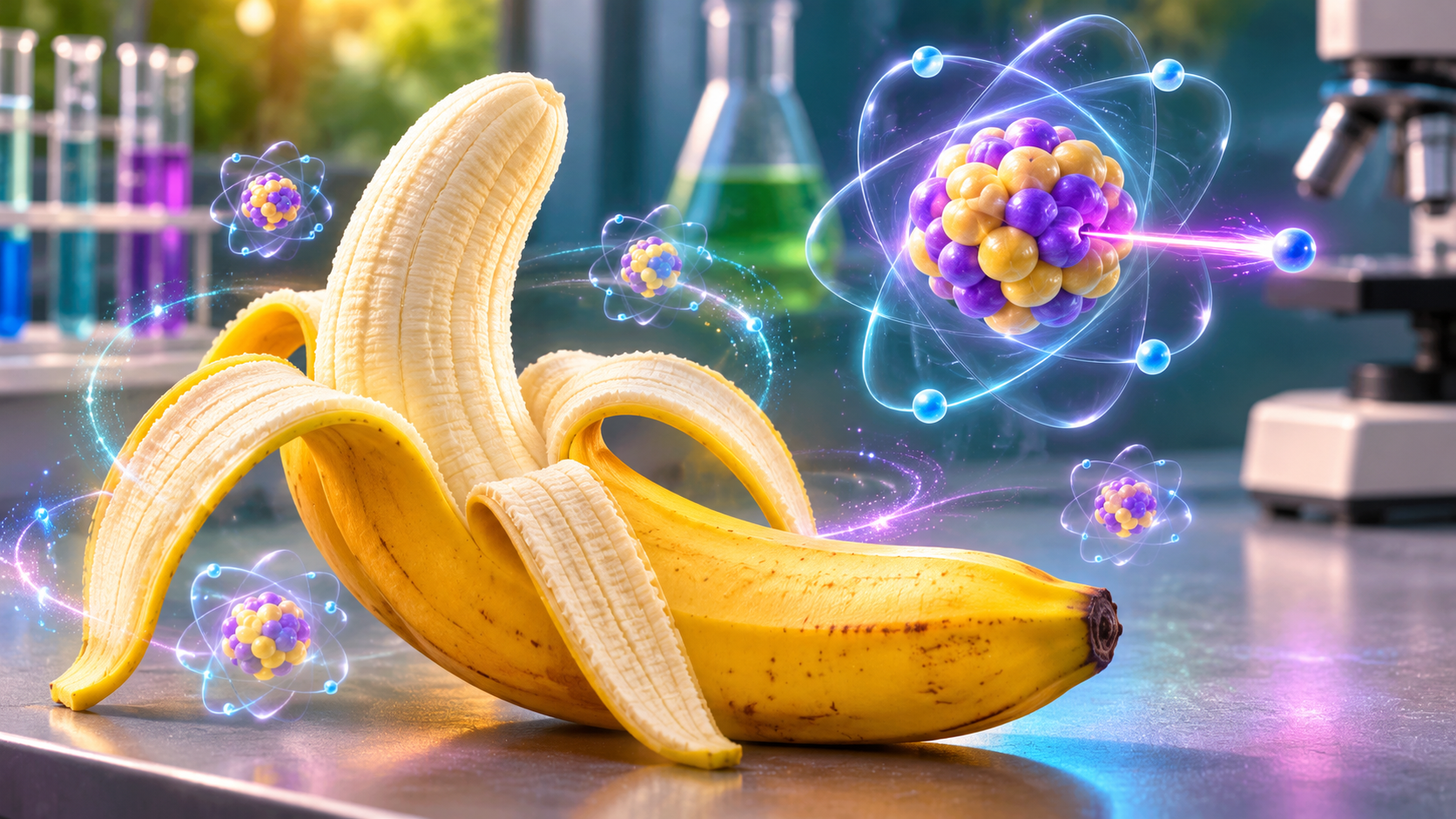
Imagine peeling a banana at lunchtime, ready for a quick snack. It looks completely ordinary, but there’s something surprising hiding inside. That banana is radioactive!
Yes, you read that correctly. Radioactive bananas are real, and every banana contains tiny amounts of material that releases radiation. Even more surprisingly, your own body is radioactive too.
Before you throw your fruit into the nearest nuclear waste bin, there’s some reassuring science to explore. Bananas are perfectly safe to eat, and their natural radioactivity offers a fascinating way to understand atoms, radiation and some important ideas from GCSE Science.
Why Are Bananas Radioactive?
Bananas contain an essential mineral called potassium. Your body needs potassium to help your muscles contract, your nerves send electrical signals and your heart work properly.
However, not every potassium atom is exactly the same.
Atoms of the same element always have the same number of protons, but they can contain different numbers of neutrons. Scientists call these different forms isotopes.
Most potassium atoms are stable. This means their nuclei do not spontaneously break down. However, a tiny proportion are an unstable isotope called potassium-40.
Potassium-40 has 19 protons and 21 neutrons. Its nucleus can change through a process called radioactive decay, which releases ionising radiation.
In fact, roughly 0.012% of naturally occurring potassium is potassium-40. That may sound like almost nothing, but bananas contain an enormous number of atoms.
As a result, a typical banana experiences around a dozen radioactive decays every second!
The same process is happening in other foods, including potatoes, beans and nuts. Radioactivity is far more common in nature than many people realise.
What Happens Inside a Radioactive Atom?
To understand radioactive bananas, we need to look inside an atom.
Every atom contains a nucleus made from protons and neutrons, with electrons surrounding it. Some combinations of protons and neutrons are unstable.
When an unstable nucleus changes, it releases radiation. Scientists call this radioactive decay.
Potassium-40 usually decays by releasing beta-minus radiation. During this process, a neutron changes into a proton, producing an electron that escapes from the nucleus as a beta particle. Another tiny particle, called an antineutrino, is also released.
This changes potassium-40 into calcium-40, a stable isotope of calcium.
Potassium-40 can also decay by a different process that produces argon-40, sometimes releasing gamma radiation.
However, radioactive atoms do not all decay at once. Their decay is random, so scientists cannot predict exactly when one particular nucleus will change.
Instead, they use half-life to describe how quickly a radioactive substance decays.
Half-life is the time taken for half the unstable nuclei in a sample to decay.
Potassium-40 has an astonishing half-life of approximately 1.25 billion years!
That means a sample containing 1,000 potassium-40 atoms would, on average, have around 500 remaining after 1.25 billion years. After another 1.25 billion years, around 250 would remain.
So, potassium-40 has been slowly decaying since long before humans existed.
How Much Radiation Does a Banana Produce?
Scientists measure the biological effect of radiation exposure using a unit called the sievert (Sv). For small doses, they use microsieverts (µSv).
One microsievert is one-millionth of a sievert.
A typical banana is often associated with a radiation dose of approximately 0.1 microsieverts.
This estimate led to an unusual comparison called the Banana Equivalent Dose (BED).
The idea is simple: scientists and science communicators can use bananas as an informal way to help people imagine extremely small amounts of radiation.
For comparison, people in the UK receive around 2,200 microsieverts each year from natural background radiation, on average.
However, the banana equivalent dose is only a rough comparison. Eating lots of bananas does not simply add up radiation doses in the way these figures might suggest, because our bodies regulate potassium.
It is also useful to understand that radioactivity and radiation dose are different things.
Scientists measure the activity of a radioactive source in becquerels (Bq). One becquerel means one radioactive decay per second.
Sieverts, meanwhile, measure radiation dose in a way that accounts for its biological effects.
So, a substance can contain radioactive atoms without presenting a significant health risk.
Why Are Bananas Safe to Eat?
You might be wondering why eating something radioactive doesn’t make you ill.
The answer involves both physics and biology.
First, the amount of radioactive potassium in a banana is extremely small. The radiation associated with it is tiny compared with the background radiation we encounter naturally.
Second, your body already contains potassium, including small amounts of potassium-40. You are naturally radioactive!
Your body carefully controls its potassium levels through a process called homeostasis. This means keeping internal conditions within healthy limits.
Your kidneys help remove excess potassium through urine. Therefore, eating another banana does not cause radioactive potassium to build up endlessly inside you.
This is why the banana equivalent dose is not a reliable way to calculate the effects of eating hundreds or thousands of bananas.
Of course, ionising radiation can be dangerous at sufficiently high doses. It has enough energy to remove electrons from atoms and may damage living cells, including their DNA.
However, the important factor is the dose received, not simply whether something contains radioactive material.
In normal circumstances, the natural radioactivity in bananas presents no meaningful health concern.
Radioactivity Is Everywhere – Even Inside You!
Bananas are not unusual because they are radioactive. They are unusual because they make an invisible part of science easy to understand.
We constantly encounter background radiation, which comes from natural and human-made sources around us.
Some arrives from space as cosmic radiation. Some comes from radioactive rocks and soil. Small amounts even come from the food we eat and the atoms inside our bodies.
One particularly important natural source is radon gas, which can enter buildings from the ground. Unlike the tiny amount of radiation associated with bananas, long-term exposure to high radon levels can increase the risk of lung cancer.
This difference helps explain an essential scientific principle: radiation risk depends on the type of exposure, the dose and how it reaches the body.
It also connects several GCSE Science topics, including atomic structure, isotopes, radioactive decay, half-life, ionising radiation and homeostasis.
So, next time you pick up a banana, ask yourself: if something can be radioactive and still completely safe to eat, what does that tell us about the importance of understanding scientific risk?
Science often challenges our first impressions. The word radioactive might sound frightening, but the evidence tells a more interesting story.
And perhaps the strangest part is that, while you’re eating your radioactive banana, you’re already radioactive yourself!



Leave a Reply